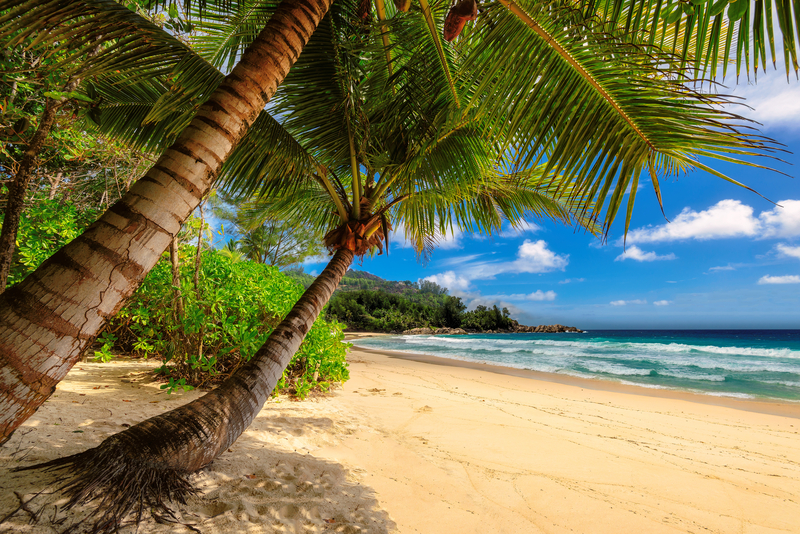
Jamaican tourism is the foundation of its development strategy. Some of the country’s all-inclusive beach resorts are owned by locals and others by multinational chains. Credit: Luckyphotographer|Dreamstime.com.
Tourism is a major source of revenue for many low- and middle-income countries, employing up to half of the workforce in The Bahamas, for example. However, economists have rarely examined the impact of tourism on local prosperity. That research gap created a perfect dissertation topic for recent AAE graduate Matthew McKetty, who decided to focus on his parents’ homeland: Jamaica, an upper middle-income country of 2.8 million people where tourism-related sectors account for 30% of GDP.
His advisor, AAE professor Jeremy Foltz, asked him to assemble a strong dataset to answer his question of interest—and McKetty took that advice to heart. “I traveled to Jamaica and met with different government officials on several occasions until I found the right person to talk to,” he says. “My persistence paid off, and I am grateful to those who answered my emails and helped me build the dataset I needed.”
McKetty found that tourism improved Jamaican prosperity but not across the board: Greater tourism revenues increased real (inflation-adjusted) spending by urban but not rural households. The spending increases were mostly driven by mid-skilled, private-sector employees in non-tourism services and manufacturing. These are typically workers who have graduated from high school and completed some type of vocational training.
McKetty’s analysis relied on a unique dataset collected by Jamaica’s Ministry of Tourism. Created as part of the government’s strategic plan to promote economic development through tourism, the agency has been conducting detailed foreign visitor exit surveys since 2000. They confirmed the distinct nature of Jamaican tourism: In 2023, for example, 90% of hotel room nights were booked in all-inclusive resorts by the two-thirds of visitors who stayed for more than 24 hours.
McKetty combined expenditure surveys from more than 150,000 overnight visitors with financial census data from 30,000 nationally representative households with almost 100,000 residents. He merged 2001-2021 tourist and household surveys by “enumeration district,” the smallest geographic unit that is similar in concept to U.S. census tracts.
McKetty’s analysis showed that a $10 million increase in tourism revenues in an urban area caused that area’s households to increase their real food- and non-food expenditures by 2.3% and 2.9%, respectively. In the median urban household, this meant a $97 increase in annual per-capita consumption. Medical services and products accounted for one-third of the non-food category.
“This means that tourism has real benefits for urban populations, but provides less help elsewhere,” says McKetty. “Unfortunately, the most vulnerable and poorest part of the population that the government hopes to target is not yet experiencing significant and consistent benefits.”
This illustrates the difficulty of creating “back-linkages” between tourism and other sectors of the economy to generate prosperity across industries and regions. McKetty also notes that more research is needed to fully explain his results.
One possibility is that new tourism service jobs add pressure to the labor market, raising incomes in non-tourism sectors. McKetty’s analysis of more than 6,000 households that were sampled by the census more than once identified changes in the overall income distribution. However, this aggregate analysis could not link wage changes to individual workers.
Another possibility is a positive spillover effect, where an influx of tourists into a region creates new jobs in manufacturing. This may include the construction industry—for buildings, furniture and other hotel and restaurant infrastructure—and firms producing food, clothing and other products for which tourists raise demand. An earlier study reported similar effects in Mexico, where regions with greater tourism revenues experienced population growth and higher employment in domestic manufacturing.
The Jamaica analysis produced another result, both positive and unexpected. “I found no evidence for local inflation as in New York, Paris and Barcelona, where visitors and locals intermingle and everything from coffee shop prices to housing costs has increased dramatically in recent years,” says McKetty. “All-inclusive tourism has a bad reputation in some circles as it separates tourists from locals, but one of its lesser-known benefits is the prevention of rising costs for residents.”
Foltz, who has more than three decades of experience in development economics, says the study is among the first rigorous assessments of tourism’s impact on emerging economies. Its broader context is the traditional narrative of structural transformation, which has viewed manufacturing as the main driver of economic growth.
“Since manufacturing is no longer taking off like it used to, the service sector is actually the fastest-growing one in Africa and many other low- and middle-income countries,” says Foltz, who is also the faculty director of UW-Madison’s African Studies Program. “Tourism employs many of the low-skilled workers that manufacturing used to absorb from agriculture. But whether or not the service sector can fill manufacturing’s role in raising living standards through long-term productivity growth is still an open question.”
McKetty’s pioneering work, adds Foltz, shows the potential, and some of the pitfalls, of tourism as an engine of economic growth and structural transformation for poor developing countries.