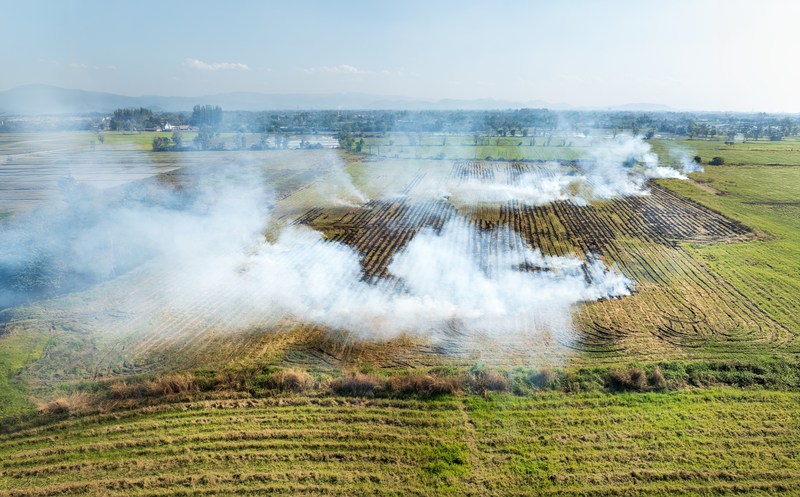
Burning crop residue after the harvest season generates air pollution. More sustainable agricultural practices avoid burns and use residues as year-round soil cover instead. Credit: Toa555|Dreamstime.com.
Agricultural activities account for 20% of global air pollution, but crop farmers can reduce emissions—and often boost yields—with more sustainable soil cultivation practices. A new study in Mexico led by AAE faculty affiliate Joel Ferguson reported a third, surprisingly large benefit: The reduction in urban air pollution due to the widespread adoption of soil-regenerative practices averted more than 5,200 infant deaths from 2012 to 2022.
The economic value of these health benefits alone exceeded $1.1 billion, more than 14-times the cost of the government-supported program that helped Mexican farmers change their practices.
“Mexico’s conservation agriculture program was designed as a climate adaptation policy with anticipated environmental and productivity benefits,” says Ferguson, an assistant professor of sustainable land systems at the Nelson Institute for Environmental Studies. “The greater infant survival rate caused by better air quality was not on the radar of policymakers but emerged as a substantial co-benefit of this extremely cost-effective program.”
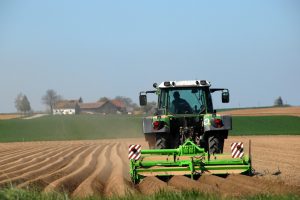
Conservation agriculture is the world’s most common “sustainable intensification” technology. Its main features in Mexico’s MasAgro program are minimal soil disturbance and permanent soil cover: Farmers refrain from tilling and leave crop residues on the ground instead of burning them. Links between conservation agriculture and improved air quality are plausible. No-tilling means less dust from land preparation activities, no-burning avoids combustion pollutants and permanent coverage reduces dust from the wind erosion of bare soil.
Mexico was an ideal study location because the national roll-out of conservation agriculture included extensive data collection efforts. Since January 2012, extension technicians at the International Maize and Wheat Improvement Center (CIMMYT) have educated more than 15,000 farmers and collected agronomic data, including the time of adopting new soil cultivation practices, for almost 77,000 hectares of land.
Ferguson and his CIMMYT colleagues analyzed 130 urban areas with at least 100,000 residents in 2010 and at least one nearby farm that adopted no-till, no-burn practices during the study period. The team combined the agronomic data with birth and death records from the Department of Health and air pollution monitoring data from the National Institute of Ecology and Climate Change.
Since remotely sensed air pollution and soil cover data was available at much higher spatial coverage, adding satellite imagery and detailed weather information further enhanced the value of this rich dataset. The team divided the study area into a grid of more than 13,000 cells, or 11-kilometer (6.8-mile) squares, and calculated satellite-derived proxies of particle pollution and soil cover for each.
The satellite data provided two advantages: First, the soil cover proxy measured the broader diffusion of conservation agriculture throughout Mexico since many farmers changed practices without receiving extension services. Second, the almost-random variation in daily wind directions within each cell was key to establishing a causal link between soil cultivation practices and changes in air pollution and infant mortality.
The adoption of conservation agriculture caused a 13% reduction in the daily maximum of fine-particle pollution and 13.2 fewer infant deaths from respiratory and cardiovascular causes per 100,000 births. Male infants made up 58% of the 5,257 saved lives. Since the effect size reached its peak during the off-season, the most likely explanation was less dust and fewer combustion pollutants from changes in post-harvest land preparation activities.
“Beyond the societal benefits, the satellite data also corroborated earlier reports of increased crop productivity after adopting soil-regenerative practices,” says Ferguson. “In most cases, this means higher profits for farmers.”
The “triple benefits” for human health, farmer income and the environment were encouraging but may not be achievable everywhere, cautions Ferguson. For example, back-to-back cropping systems, such as rice followed by wheat, are common in India and require the fast clearance of land between rotations. In this case, other strategies will be needed to replace the burning of crop residues.
Mexico’s policy is an example of broader efforts to reduce the environmental impact of global food systems. This work often starts with developing new technologies and testing them on side-by-side laboratory plots. But it is notoriously difficult to extrapolate experimental findings to real-world settings.
“Our results show that agricultural programs may also affect outcomes, in this case human health, that we can only measure and analyze in the real world, not in lab experiments,” says Ferguson. “That makes our study a potential model for evaluating other climate adaptation policies for global food systems.”