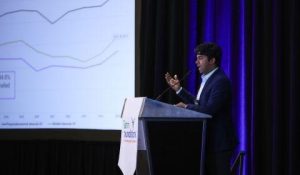
Raagav Vijayalakshmi Siva, a senior majoring in agricultural business management, was selected to participate in the Farm Foundation Cultivator Program and attend the June 2026 Farm Foundation Round Table in St. Louis, Missouri. The program brings together selected undergraduate and graduate students with leaders from across the agriculture industry, including agribusiness executives, policymakers, researchers, and economists. As part of the program, Raagav conducted an independent research project and presented his findings at the Round Table. Paul Mitchell, Professor and Chair of the Department of Agricultural and Applied Economics, asked Raagav about his experience.
Paul Mitchell: What is the Farm Foundation Cultivator Program, and what did you do as part of it?
Raagav Vijayalakshmi Siva: The Cultivator Program gives students an opportunity to participate in Farm Foundation’s Round Table, which brings together people from across agriculture to discuss some of the biggest issues facing the industry. This year’s theme was “Beyond the West: U.S. Agriculture in a Realigning World.”
As a Cultivator, I developed a research project looking at U.S. almond exports from 2014–2025. I was interested in how agricultural value chains are changing as emerging markets become increasingly important consumers and processors of U.S. agricultural products. I looked at trade in raw and processed almonds, export values and major destination markets to understand where value is being created and captured along the supply chain.
I then presented the research through a five-minute presentation and poster at the Round Table. It was a great exercise in taking weeks of data and analysis and turning it into something that could start a conversation with people working in agricultural economics, trade, policy and agribusiness.
The Department of Agricultural and Applied Economics also provided travel funding that helped make it possible for me to attend the Round Table in St. Louis. Having that support allowed me to take what I had been learning at UW–Madison and apply it in a national agricultural setting.
PM: What were some of your highlights from the Round Table?
RVS: One of the biggest highlights was getting to experience agriculture from so many different perspectives in just a few days. Throughout the Round Table, we had conversations about biofuels and ethanol production, agricultural trade, farm diversification, supply chains and the future of the industry. Some conversations looked at agriculture from a macroeconomic and global perspective, while others focused much more closely on individual farms and businesses.
The final day was a field day around St. Louis. We started with an agricultural tour of the Mississippi River, which gave us a different perspective on how important the river and its infrastructure are to moving agricultural commodities. We then visited Bunge and Bayer Crop Science. At Bayer, we toured several labs and learned about their biological sciences and seed development work. Seeing those operations in person was a nice complement to the economic and policy conversations we had been having throughout the week.
Another major highlight was the people. I met undergraduate and graduate students from land-grant universities around the country who were interested in agricultural business, economics and policy. I also met professionals who had previously participated in Farm Foundation programs. Those conversations were especially valuable because I could hear about their careers, ask questions and learn how they had found their own paths within agriculture.
PM: What is something you learned from the experience that you will take with you going forward?
RVS: My biggest takeaway was probably just how interconnected the agricultural industry is. Over a few days, we went from talking about global trade and the future of U.S. agriculture to biofuels, ethanol, farm diversification, transportation infrastructure, seed development and agricultural technology. It made it difficult to think about any one part of agriculture in isolation.
That connected closely with my own research. Looking at almonds started as a trade analysis, but it quickly became a question about processing, consumer markets, supply chains and where value is actually captured. Similarly, the conversations at the Round Table showed me that changes in trade policy, energy markets or consumer demand eventually affect decisions being made by individual agricultural businesses and producers.
I also came away appreciating how valuable it is to take research outside of the classroom. Presenting to people working in these industries forced me to think beyond the analysis itself and ask a much simpler question: “Why does this matter?” That is something I will carry with me going forward.
PM: Would you recommend the Cultivator Program to other students, and who would be a good fit?
RVS: Absolutely. I would especially recommend it to students interested in agricultural business, economics, policy, food systems or really anyone who wants to better understand how different parts of agriculture fit together.
The Cultivator cohort was a big part of the experience for me. Being around undergraduate and graduate students from other land-grant universities who were studying similar issues made it easy to exchange ideas and learn about what other students were researching. At the same time, the Round Table gave us access to people who had spent years working throughout the agricultural industry.
For me, that combination was what made the program so valuable. I could present my own research, learn from other students, meet professionals in the industry, visit agricultural companies and infrastructure, and hear discussions about where agriculture is heading—all within the same experience. I am very grateful to Farm Foundation for selecting me as a Cultivator and to the Department of Agricultural and Applied Economics for providing the financial support that helped me participate.