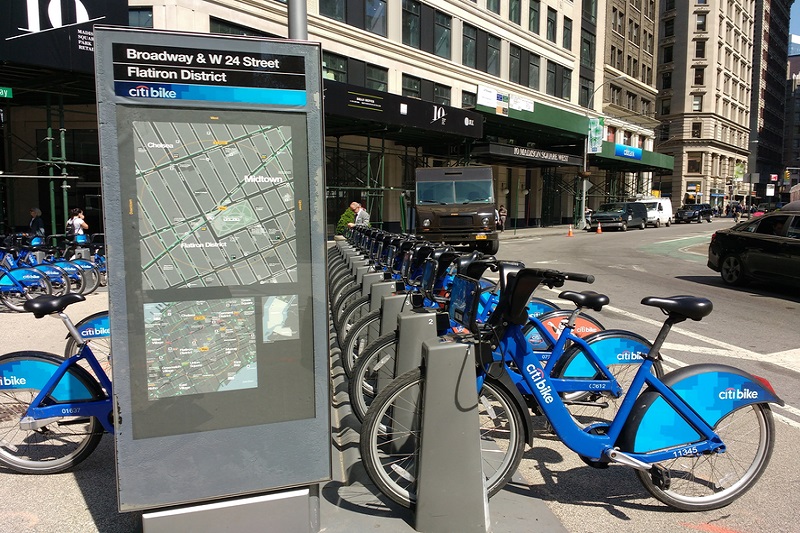
App-based bike sharing systems have become a common fixture in many large and mid-sized U.S. cities during the last decade. Credit: Erin Alexis Randolph|Dreamstime.com.
In 2014, New York City launched its first bike sharing system—similar to Madison’s Bcycle—to give both residents and tourists a new option to get from A to B. Nine years later, the number of accidents with cyclist fatalities reached a 23-year high: 30 deaths, 23 of which were e-bike riders.
Statistics like this piqued the interest of daily bike commuter and recent AAE graduate Garrett Shost. As part of his dissertation, he decided to study the impact of bike sharing systems on traffic accidents in large U.S. cities.
“When I see people using Madison’s e-bike sharing system, I often notice them not wearing helmets, which is a safety concern,” says Shost. “On the other hand, more bikers could make our roads safer by taking drivers off them. The ambiguity of the net effect on overall traffic safety made this a really interesting research topic.”
Since his PhD advisor, Anderson-Bascom Professor Dominic Parker, agreed with that assessment, Shost began to compile 6.5 years of data from eight large U.S. cities. He combined daily traffic accident reports with daily ridership information from bike sharing systems (BSS), most of which provide a mix of manual and e-bikes.
His main finding confirmed the trend observed in New York City: From July 2017 to December 2023, per-capita traffic accidents increased with greater BSS usage. But his second result was more encouraging: Bike infrastructure, such as bike lanes and dedicated bike paths, mitigated this increase and improved road safety.
Shost analyzed 19,000 data points from Washington, D.C.; Austin, Texas; Boston, Massachusetts; Chicago, Illinois; Los Angeles, California; New York City, New York; San Francisco, California; and San Antonio, Texas. Resident numbers ranged from 687,000 to 8.3 million, with an average of almost 18,000 daily users in 2023. The largest growth in ridership occurred in San Francisco, where users increased more than fivefold from 44,000 in July 2017 to 234,000 in July 2023.
Since e-bikes are pedal-assisted, both types of cyclists experience the proven health benefits of increased physical activity. According to previous estimates, only 2-10% of BSS users choose bikes to replace a car trip. About one-third replace a public transit trip, and the rest either replace a walk or would have stayed home otherwise.
Shost selected the eight cities based on data availability and a top-20 rank in population size. His analysis controlled for many other factors that influence traffic accidents: city attributes, such as population size, income, education level and the share of roads with bike infrastructure, and weather features that influence bike usage, such as wind speed, precipitation and temperature.
After the first U.S. systems were introduced in the early 2010s, they rapidly grew in popularity and had reached more than 150 cities by 2022. The vast majority (85%) are app-based, non-docked systems that maximize ease of access: New users pick up a bike wherever previous users have left it. While the 15% of docked systems have constrained pick-up and drop-off locations, the built-in charging stations mean that any e-bikes have a much higher probability of being (almost) fully charged.
The ease of access explains much of the popularity of BSS: Users can typically start riding within minutes of deciding on that mode of transportation. But it also means they often operate the bikes unprepared and are much less likely to wear helmets. That’s a notable difference from regular riders of manual bikes, many of whom—like Shost—had parents who engrained helmet-wearing in their young children’s mind.
“Biking is actually the most dangerous form of transportation per mile traveled, compared to driving, walking or taking public transit,” he says. “This is especially true for e-bikes: Their faster speed increases the severity and likelihood of accidents due to higher-impact collisions and because car drivers tend to underestimate a biker’s pace.”

With these explanations, the study’s main result is less surprising: A 10% increase in per-capita BSS usage was associated with a roughly 1% increase in accidents. Cyclists themselves experienced the biggest negative effects—injuries and fatalities—as they were logging many more miles than before the BSS launch.
That launch was like an external shock to a complex system, with cities experiencing sudden increases in bike numbers and road hours. Without investing in infrastructure upgrades to absorb this shock, unintended consequences co-occurred with the intended benefits of reduced congestion, better air quality and greater physical activity. Thus, one of the study’s take-home messages is a call for urban planners to promote bike lanes in cities that have embraced bike sharing systems.
“Holding BSS usage constant, fewer collisions occurred in cities with more bike lanes and dedicated bike paths,” says Shost. “This means a growing interest in switching from cars to bikes for commutes and recreational trips combined with more extensive cycling networks could create a win-win outcome for many cities.”