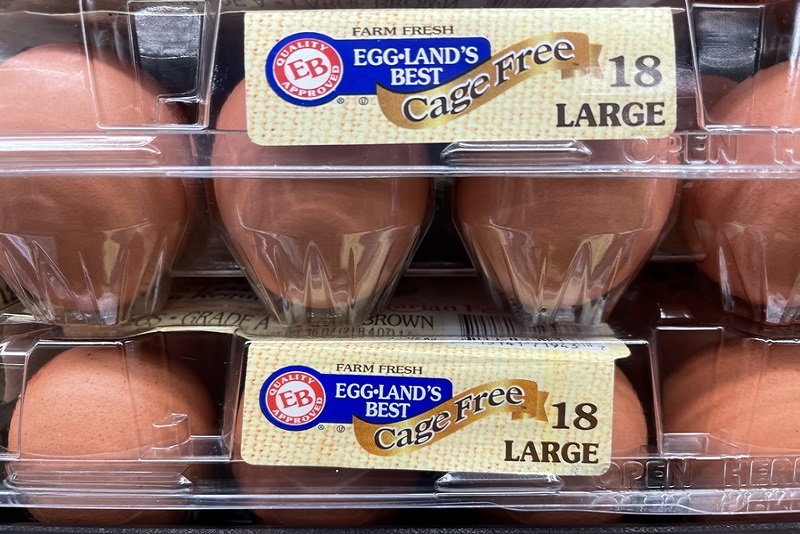
Many American consumers can choose between conventional, cage-free, free-range and pasture-raised eggs in the grocery store. Each label implies different levels of hen welfare. Credit: Billy Blume|Dreamstime.com.
Trevor Woolley did not grow up on a farm but greatly enjoys talking to food producers, from almond farmers in California to dairy farmers in Wisconsin. During his graduate training at UC Berkeley, those conversations made him realize that many producers are caught between a rock and a hard place.
“They have to make a living from their crops or livestock operations while also caring for their land and animals,” says Woolley, who joined AAE as an assistant professor in July 2026. “Market competition can encourage crop farmers to use innovative technology to help cut costs. But when living animals are involved, that cost-cutting can be pernicious for livestock farmers who are already competing on very thin profit margins.”
The welfare of these living animals holds value for producers and consumers but is not traded in traditional marketplaces. Quantifying the monetary worth of such goods requires non-market valuation: a core tenet of environmental economics that first sparked Woolley’s interest as an undergraduate student at Brigham Young University. It was still on his mind when he pursued his Ph.D. in agricultural and resource economics a few years later.
In economic jargon, the treatment of farm animals is a potential “negative externality” in agricultural markets: an unintended cost borne by livestock, outside of the transaction between producers and consumers. Animal welfare economics turned out to be a nascent field with numerous open questions for Woolley to explore in his dissertation and, going forward, in his research program at UW-Madison.
“The outreach component of my appointment includes farm visits to ground my academic work in real-life problems faced by Wisconsin producers,” says Woolley, who is also affiliated with the Dairy Innovation Hub. “I think animal welfare is a super-exciting topic because the public really cares about it and yet, it is full of misperceptions and knowledge gaps.”
Take the example of cage-free eggs. In the United Kingdom, they are identical to “free-range” eggs in American grocery stores: Hens have some access to outdoor space, but the size of the area and the allowed access time are variable. In contrast, the U.S. “cage-free” label simply describes the lack of traditional, cramped battery cages: Hens have access to water and food at all times but may still live in crowded conditions in large barns or warehouses. In both countries, “pasture-raised” hens spend substantial time outdoors on a grassy field, with a minimum required space per bird.
Cage-free eggs also inspired Woolley to develop a new strategy for estimating the public’s willingness to pay for greater animal welfare. It was grounded in a vote-buy gap, which occurs whenever more people are willing to change their collective than individual (spending) behavior. In this case, only 25% of California consumers paid an extra $0.65 per dozen cage-free eggs, yet 62.7% of voters supported a ban on caged-egg sales in a 2018 ballot initiative called Proposition 12.
“That large vote-buy gap was evidence that voters have some ‘non-use value’ for cage-free eggs that is detached from their personal consumption,” explains Woolley. “The method I developed in my thesis uses that gap to estimate voter willingness to pay for the policy and its non-use value share.”
A non-use value is the economic worth people assign to goods they have neither used in the past nor expect to use in the future. Here, it is the existence value of hens having better lives for all Californians: those who pay the price premium for cage-free eggs, those who buy caged eggs and those who never buy eggs. In other words, if people only cared about the welfare of hens whose eggs they personally consume, the market alone would determine public willingness to pay. Otherwise, the market underprovides for hen welfare.
To estimate the non-use value of cage-free eggs, Woolley combined three data sources: 2018 retail purchases of caged and cage-free eggs in California, according to barcode scanners; precinct-level voting outcomes for Proposition 12; and demographics from the American Community Survey. A spatial matching strategy produced a dataset of almost 20,000 observations.

Non-use value accounted for at least 59% of voter willingness to pay for cage-free eggs, equivalent to $9 of $15. “Since most of that $15 is non-use value, this is evidence from revealed voter preferences that animal welfare is a public good benefiting everyone,” explains Woolley. “That is a strong justification for enforceable industry standards.”
Some emerging regulation, such as the European Union’s common agricultural policy 2023-27, goes beyond bans like Proposition 12 by providing direct payments to farmers who implement welfare-improving practices. The most feasible practices provide clear benefits at relatively low costs. Upgrading indoor environments with better ventilation, natural light or sanitation, for example, improves animal health, which lowers veterinarian costs and boosts productivity.
Woolley is optimistic about the future of animal welfare gains, especially if consumer labels better reflect actual farming practices. Human values for animal welfare, he notes, seem to be universal and less polarized than many environmental issues—and policymaking is just one of several channels.
“I think supporting producers to get together and share ideas about humane farming practices is also very important,” says Woolley. “This is something I hope to pursue, especially since producer-led watershed groups have already been successful in reducing Wisconsin surface water pollution by sharing soil conservation practices.”