When Credit Lines Open Fault Lines: Economic and Political Effects of Bank Lending
Presented by:
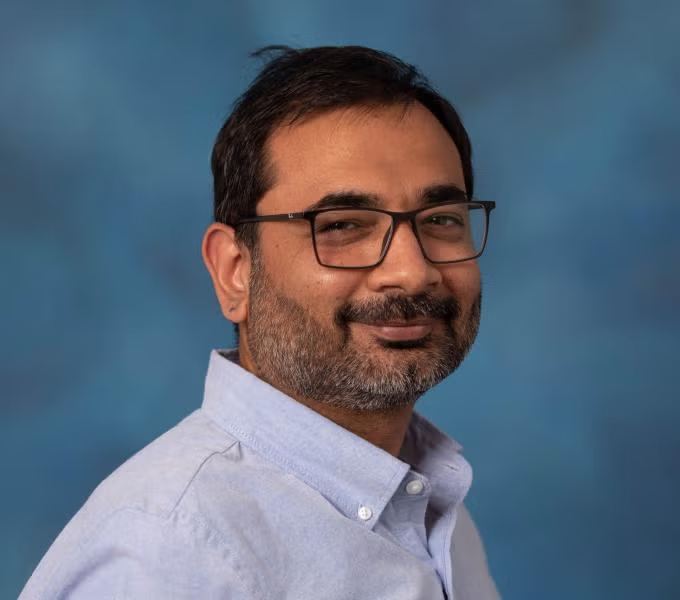
Yasir Kahn
Department of Economics
University of Pittsburgh
Thursday, April 23, 2026
3:45 pm-5:00 pm
Taylor-Hibbard Seminar Room (Rm103)
Online - https://urldefense.com/v3/__https://y-khan.github.io/yasirkhan.org/khan_ritadhi_minority.pdf__;!!Mak6IKo!NVFnruMk3qjCcmjLvrAjtVBR09oIR6oI8rjPzEuXUUp-RozgAR0jo-_hIjRkFaU_kw825Ac7_02mpL77H_4_$
This paper examines how welfare policies, in states with fractured societies, result in political and social changes, using a policy intervention in India. The policy directed commercial banks to increase lending to marginalized religious minorities, such as Muslims, in “minority concentration” districts. Using a regression discontinuity design, we identify improvements in access to credit and economic well-being of Muslims households. The policy also shifted political outcomes: state elections were more likely to have Muslim candidates who also received higher vote shares and exhibited increased likelihood of winning. These changes were likely driven by Muslims overcoming collective action problems: policy districts saw a rise in exclusively Muslim Self-Help-Groups, a strengthening of Muslim identity, and greater belief in the power of collective action to protect minority rights. However, the improved economic and political standing of Muslims triggered a blow-back effect, evidenced by a rise in communal riots, primarily in post-election periods.